
Is Haemophilia a Disability?
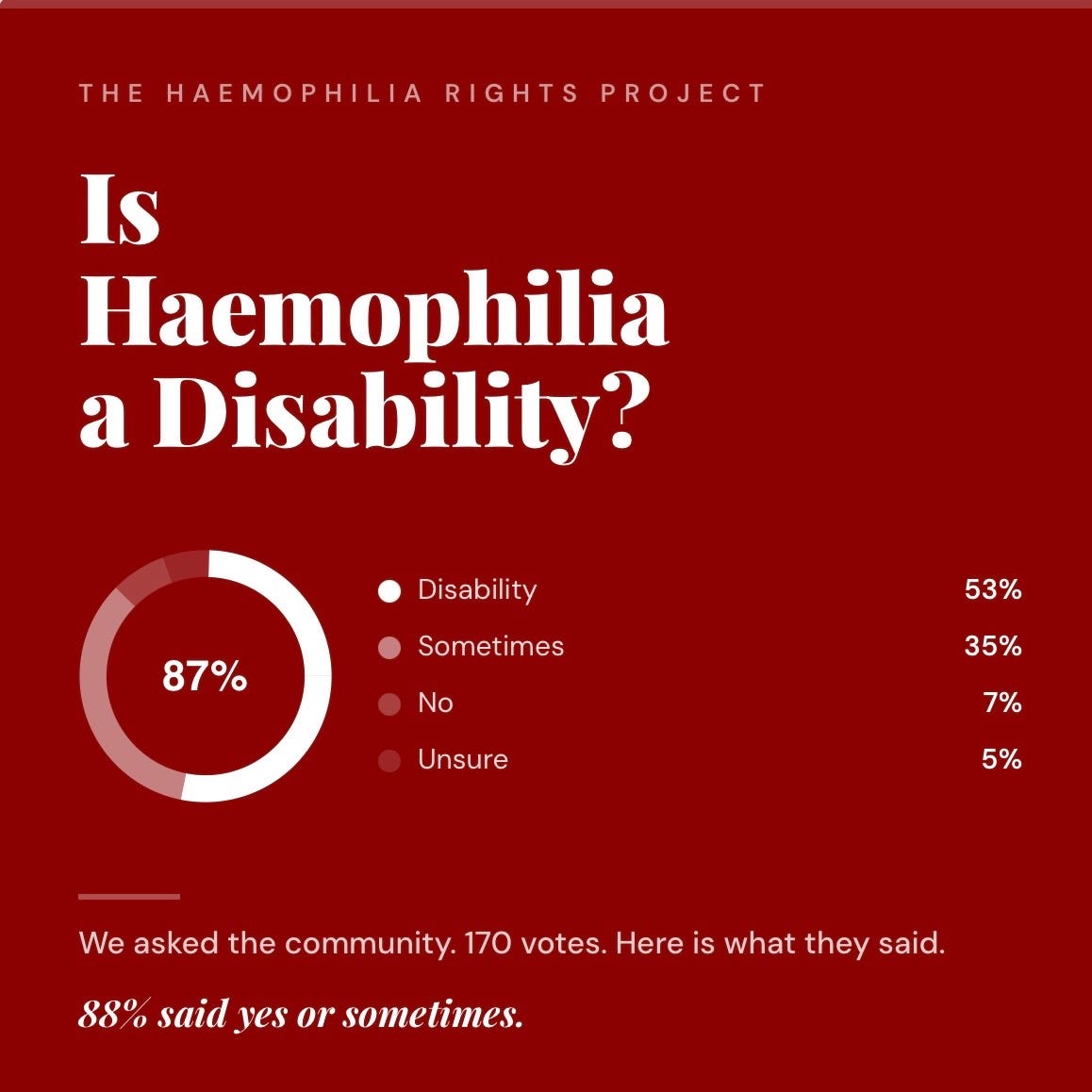
Around 170 people from the haemophilia community have voted on The Haemophilia Rights Project poll, on the question of is haemophilia a disability?
Thank you to everyone who voted. The best way to make our voices heard is as a collective one.
The purpose of this poll was not to invalidate anyone’s identity. As a person with haemophilia, you should be able to identify as disabled or non-disabled.
The purpose was to show that the vast majority of people with haemophilia believe it is a disability and that it must be treated as such legally and socially.
The results were as follows:
53% - Disability
35% - Sometimes
7% - Not a disability
5% - Unsure
88% of respondents said haemophilia is a disability either always or sometimes. Only 7% said it is not.
The Global Opinion
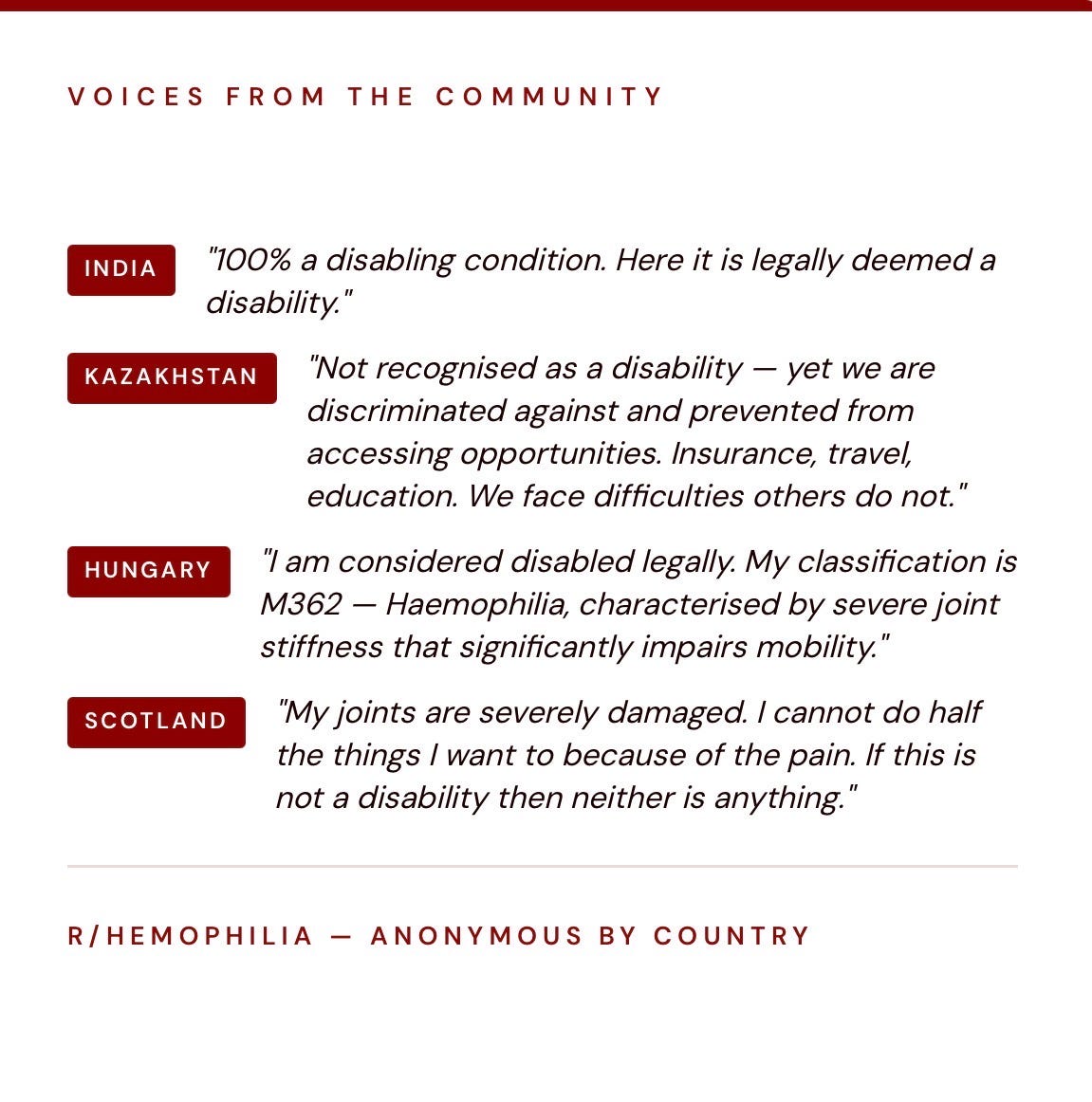
The poll received responses from across the world - including India, Kazakhstan, Hungary and Scotland - and generated 26 comments, over 2.2k views and 56 shares. This was an issue which those in r/Hemophilia and the wider haemophilia community are very passionate about.
Here are just some of the comments:
The Social Model of Disability and Haemophilia
The Social Model of disability tells us that it is not our condition itself that disables us, but the barriers created by society - inaccessible systems, lack of adequate treatment provision, poor workplace accommodations, and the failure of institutions to recognise our needs. Under this framework, haemophilia is clearly a disability.
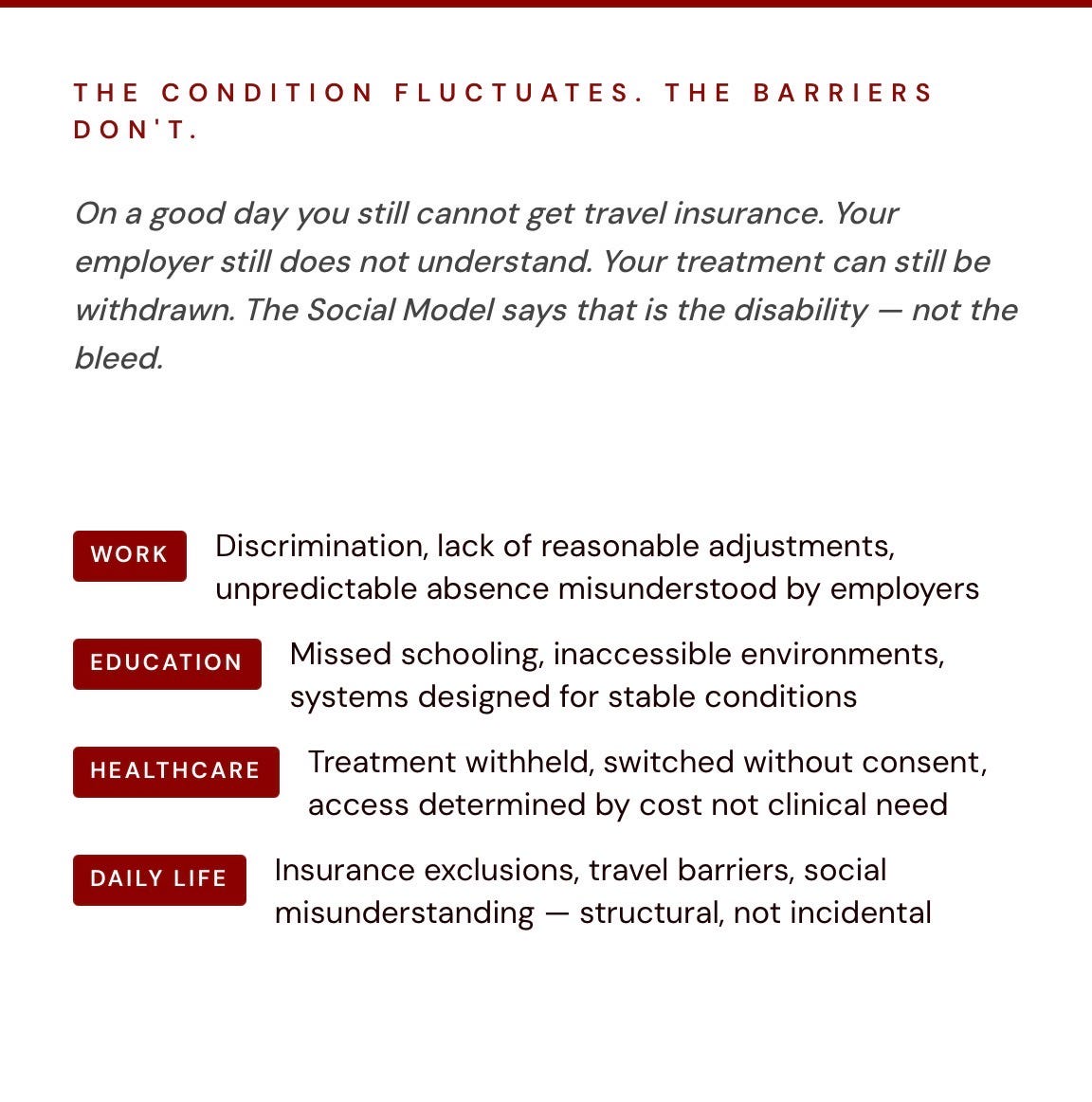
There are two main ways in which we are falling short.
(1) Legally
The legal picture varies significantly across countries - even among those that have ratified the CRPD.
Kazakhstan does not legally recognise haemophilia as a disability despite ratifying the convention. One respondent described facing barriers to education, travel and employment that peers without haemophilia do not. The label is absent. The barriers are not.
Hungary only classifies haemophilia as a disability if it has resulted in arthritis or muscle atrophy. You must wait until the condition has caused irreversible physical damage before your rights are recognised. That is not disability recognition. That is disability recognition as a last resort.
The CRPD’s broad definition of disability was intended to ensure conditions like haemophilia would be covered without states needing to name every condition explicitly. Instead, that flexibility has created space for ambiguity. States have exploited it to set their own thresholds and delay recognition. Both Kazakhstan and Hungary have ratified the CRPD. Both are in breach of it.
(2) Socially
Even where domestic law recognises haemophilia as a disability, rights are not automatically real.
The United Kingdom has the Equality Act 2010. Haemophilia qualifies under it. And yet the commissioning system prices patient choice out of existence, switching stable patients to cheaper alternatives without meaningful consent. One respondent from Scotland described joints so severely damaged that basic activities cause extreme pain - a direct impact on their ability to live independently.
Employers will take the chance at discriminating against a person with haemophilia - either assuming the consequences will be minimal, or not realising it qualifies as a disability at all. Discrimination begins at school, continues through travel insurance that will not cover you, and shows up in welfare systems that do not recognise fluctuating conditions. Many people with haemophilia do not even know the rights they are entitled to as disabled people. Rights that exist on paper but are unknown to the people they are designed to protect are no rights at all.
Haemophilia is a Disability
We each have the right to identify however we choose. I say I am disabled. Because I am - disabled by the barriers society has built around my condition, not by the condition itself.
I have a disability. Equally, as a person with haemophilia you can reject that label and many do. But we almost all agree that governments should not have that privilege. They must legally protect our community - which they have historically failed to do.
These are the two main battles the Haemophilia Rights Project needs to fight. Rights cannot be achieved if they are not binding in law. And equally, they cannot be achieved if they are not upheld by society. Both battles must be fought at the same time.
Luke McLaughlin
The Haemophilia Rights Project ✊🩸