The Mask
Masking in Haemophilia

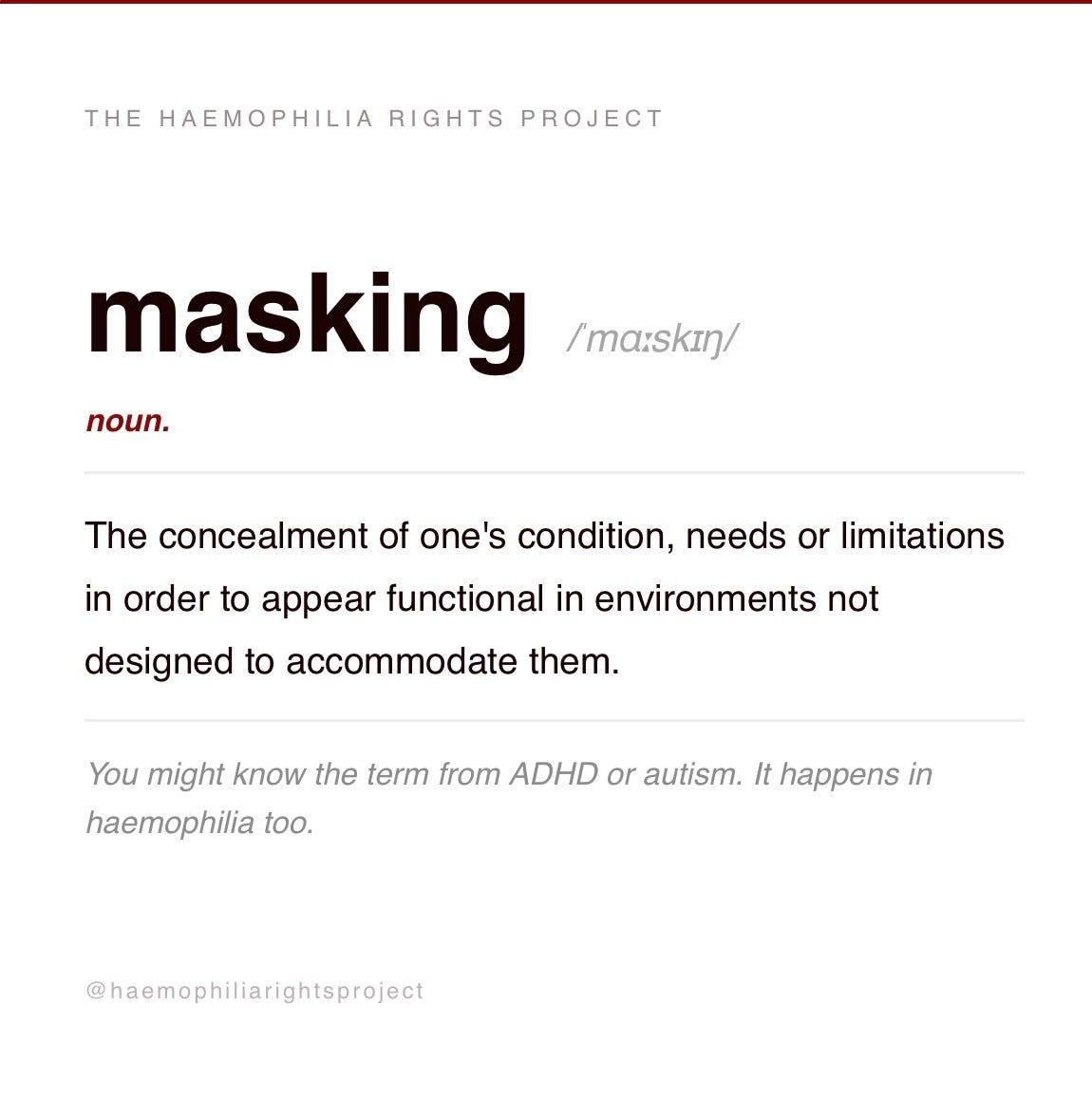
What is Masking?
Masking is the concealment of your condition, your needs and your limitations in order to appear functional in environments not designed to accommodate you - while term may not be familiar to the haemophilia community, the term is commonly used in ADHD, Autism and other non-visible disabilities. It is a common mechanism employed by people with Haemophilia to get by in the world.
Why does it even happen?
We mask because the world was not built for us and we learned that early. We have been disbelieved enough times that concealment feels safer than honesty. We know that visibility often costs us opportunities. We have learned that our needs are treated as inconveniences.
So we adopt a stoic mindset and we get on with it. It's a valuable skill but I believe we have to rely on it too often.
The trap is this: the same strength that helps us survive and thrive then becomes evidence that we are fine. Which becomes justification for not accommodating us. Which reinforces the need to mask. Which produces more resilience. And so it continues on in a never ending cycle.
When do we do it?
Not telling your employer about a bleed because you cannot afford to be seen as unreliable. Pushing through pain at school, at work, on a night out so nobody has to accommodate you. Being disbelieved by a clinician until you learn to minimise your own experience just to be taken seriously. Hearing “you look fine” so many times that you start performing fine even when you are not.
A Bupa study found that two in five employees with a less visible disability had not disclosed it to their employer. Almost a quarter said they were worried they would not be believed. One in five said they feared it would affect their career opportunities. That describes the haemophilia experience precisely.
Source: Bupa, Less Visible Disabilities in the Workplace, 2022.
What happens when the mask slips?
At some point it becomes impossible to keep up with the fine and stable version of you. The version that always managed, never complained, pushed through. When that version breaks down, people are surprised. Because you looked fine. Because you never said anything.
You get less credit for the struggle, not more. The years of managing quietly become invisible. What is visible is the moment you could not keep it up any longer.
Sometimes the clinical consequences are serious. If you have been minimising your symptoms to be taken seriously, you may present later than you should have. The mask is not only a social cost. It is a health risk.
What needs to change?
At the moment, unfortunately, masking is necessary. The system we operate within does not yet make it safe to take the mask off.
Masking is the opposite of independent living. Independent living means having genuine control over your own life - your decisions, your care, your environment. It means not calculating the cost of disclosure every time you enter a new room.
A mask-off reality only exists with a combination of stronger laws and recognition of non-visible, fluctuating disabilities. Legal frameworks need to adequately recognise the unique barriers faced by people with disabilities like haemophilia - conditions that are invisible most of the time, that fluctuate, and that do not fit the static image of disability that most legal protections were designed around.
Luke McLaughlin